Fake references: how candidates game the process and the warning signs to look for
Fake references are easier to arrange than ever. Learn how candidates game reference checks and the warning signs recruiters and HR teams should look for.
Most recruiters have a story about the reference that seemed too good to be true. The referee answered on the first ring, couldn't quite remember the candidate's job title, and praised them in language that sounded lifted from a template. Sometimes it's just a gut feeling. Increasingly, though, it's a pattern.
Fake references have moved well beyond a friend doing a favour. Paid services will now invent an employer, supply a professional-sounding referee and even set up a matching company website and email address. Online communities trade references between strangers, and AI tools can produce a convincing one in seconds.
The good news for recruiters and HR teams is that fake references almost always leave traces. Below, we look at how candidates game the reference process, the warning signs to watch for, and how to build a reference check that actually holds up.
How candidates game the reference process
Reference fraud is more common than most hiring teams assume. Research by StandOut CV in the USA found that one in four people have lied about their employer references, and almost a fifth of that group used a paid fake-reference service. Closer to home, South Africa's high unemployment and fierce competition for roles put real pressure on candidates to make their applications look stronger than they are.
Fake references tend to fall into a handful of patterns.
The friend posing as a manager
This is the oldest trick, and still the most common. A friend, partner or family member takes the call or fills in the form, playing the part of a former boss. They'll usually be enthusiastic and positive, but vague on the details, because they were never there.
The real colleague with an upgraded title
Sometimes the referee is genuine, but the relationship isn't what it seems. A peer from the same team is presented as the candidate's line manager, or a former colleague who left years earlier speaks as if they worked together recently. Everything checks out on the surface, which makes this version harder to spot.
Reference houses and paid services
Commercial "reference houses" sell entire work histories. According to People Management, some of these services offer professional references, employment verification and even company email addresses and websites to back up a candidate's story. Screening companies note that some go as far as registering a real company, so a quick registry search turns up a result.
References traded online
Online communities have made reference fraud a group activity. One Reddit community, set up for people to request job references from strangers, has tens of thousands of members. The referee may be a real person with a real job, but they've never met the candidate.
AI-polished answers
Generative AI has made every one of these tactics more convincing. A fake referee no longer has to improvise. They can produce fluent, professional answers to any questionnaire, and a candidate can coach a friend with a ready-made script.
Warning signs of a fake reference
No single red flag proves a reference is fake. A former manager may well use a personal email address because they've since left the company, and a fast reply might just mean an organised referee. What matters is the pattern. When two or three of these signs show up together, it's time to dig deeper.
In the details the candidate gives you
Start with the contact details themselves. Be wary when a referee can only be reached on a personal mobile number or a free webmail address, or when their email domain doesn't match the company they supposedly work for. Look up the company, too. A business that's hard to find, was registered recently, or has a thin website with stock photos, broken links and no physical address deserves a closer look. Check whether all of a candidate's past roles sit with small, little-known companies or the same agency, which can point to a reference house.
In how the reference comes back
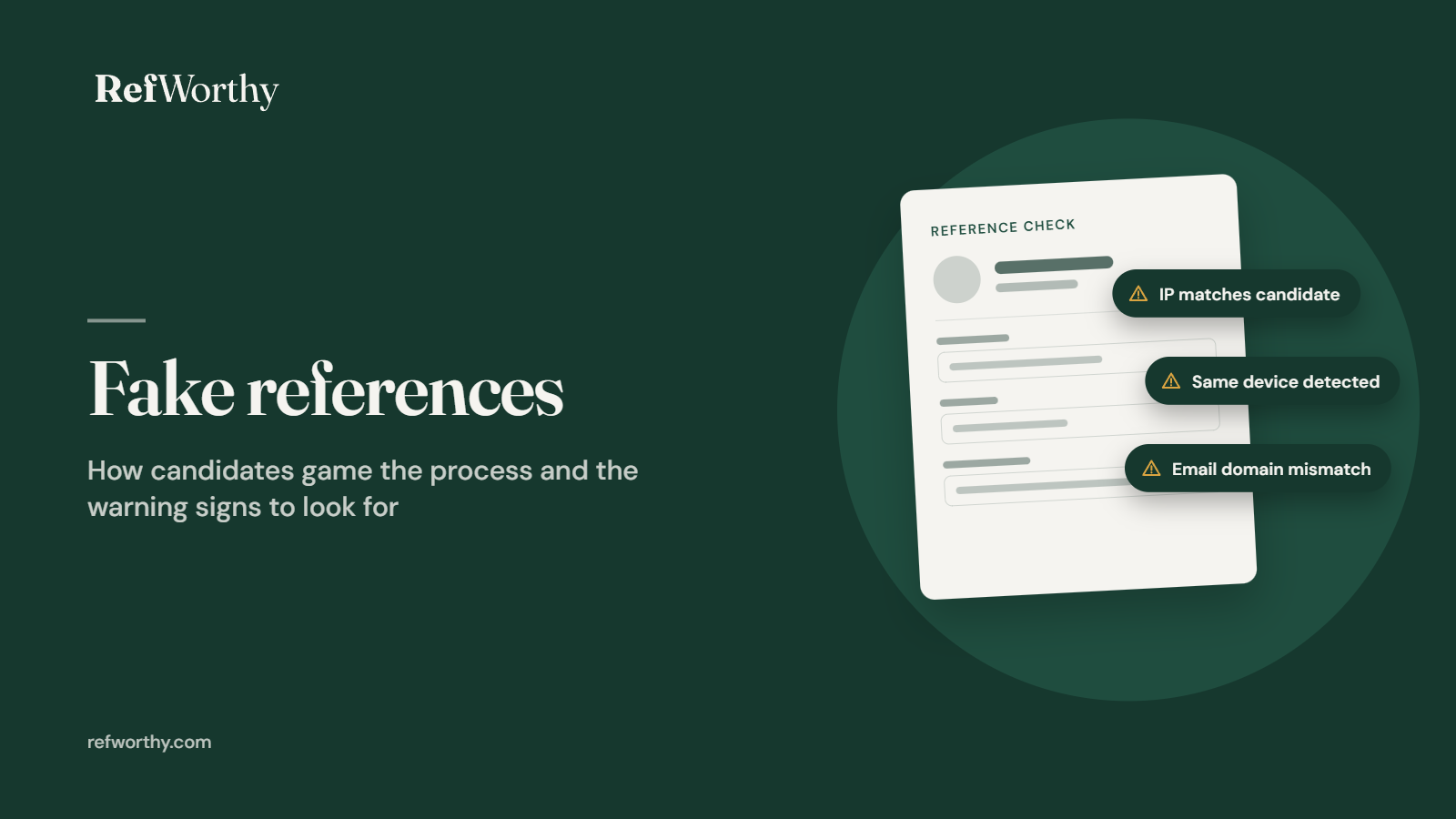
Timing and technology can give the game away. A reference completed within minutes of being sent, at the same time as the candidate was online, is worth questioning. So is a reference submitted from the same device, network or IP address as the candidate's own application. If several referees all respond from the same location, or one after another in quick succession, that's another signal.
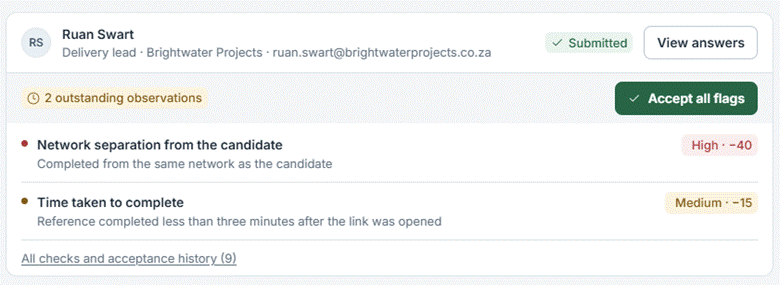
RefWorthy's suspicious activity flags help recruiters identify fake references.
In what the referee actually says
Genuine referees remember specifics: a project that went wrong, a client who loved the candidate, the way they handled a busy month. Fake referees tend to stick to generic praise, because they have nothing real to draw on. Watch for answers that are glowing but empty, job titles or dates that don't match the CV, and suspiciously similar wording across different referees. Very polished, formal answers from someone who supposedly sat next to the candidate every day can also be a sign that a script, or an AI tool, did the writing.
How to verify a reference is real
Spotting the warning signs is only half the job. The other half is a reference process that makes faking harder in the first place.

Detailed responses from referees are a good sign that the reference is not fake.
Start with consent. Under POPIA, you should tell candidates what you'll check, why, and who you'll contact, and get their written consent before you start. It protects you legally, and it sets a clear expectation that references will be properly verified, which on its own puts some people off trying to cheat. Never contact a current employer without the candidate's go-ahead.
Verify the company yourself. Don't rely on the phone number or website the candidate supplies. Look the business up on CIPC, find its main switchboard number independently, and check that the referee actually works or worked there. Keep in mind that a registered company isn't automatically a real employer, since some reference houses register companies to look legitimate.
Confirm the relationship. Ask the referee what their role was, when they worked with the candidate and whether they managed them directly. Their dates should overlap with the candidate's, and their account of the relationship should match what the candidate told you. Where you can, ask for at least one referee who was a direct line manager.
Ask questions only a real colleague could answer. Instead of "Was she reliable?", ask for a time she handled a difficult client, or how she compared with others on the team. Ask who else was on the team and what the team was working on. Genuine referees can answer these easily. Fake ones tend to stall, generalise or contradict the CV.
Compare, then follow up fairly. Set each reference against the CV, the interview and the other referees. If something doesn't add up, put it to the candidate and give them a chance to explain. A mismatched date might be an honest mistake. A referee who turns out not to exist is a different conversation.
Make verification part of the offer. Making reference verification an explicit condition of employment gives employers firmer ground if dishonesty comes to light later. It's worth discussing with your own legal adviser how to word this for South African contracts.
Where technology helps
The problem is unlikely to shrink. Research firm Gartner found that 6% of candidates it surveyed admitted to some form of interview fraud, and it predicts that by 2028, one in four candidate profiles worldwide will be fake. Manual checks will always matter, but some of the strongest warning signs are ones a person on the phone simply can't see.
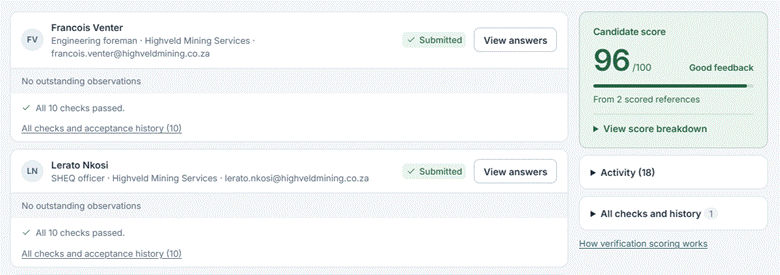
Systems like RefWorthy check suspicious activity from referees automatically.
Online reference checks can pick up what a phone call misses. When referees complete a questionnaire through a secure link, the system can check where and how each response was submitted. That makes it far easier to spot a reference filled in on the same device or network as the candidate's application, or a referee email address on a domain that doesn't match the company.
This is the kind of checking RefWorthy is built to automate. Every response runs through suspicious-activity alerts, including IP matching, same device or network detection and email domain confirmation. Requests go out from your own domain, so genuine referees recognise who's asking. Structured, weighted questions make generic answers stand out. On Pro plans and up, RefWorthy also builds a candidate profile from the CV, so you can compare dates and job titles against what referees say.
None of this replaces judgement. It does mean recruiters spend their time on the handful of references that need a closer look, instead of chasing every one by hand.
Don't let a fake reference make the hire for you
Fake references are designed to look ordinary, and that's exactly why they work. Most slip through because nobody checked the company, questioned the relationship or noticed the reference came from the candidate's own laptop, not because the fraud was especially clever.
A consistent process closes most of those gaps. Get consent, verify the employer and referee independently, ask questions that need real answers, and pay attention to how references are submitted as well as what they say. Do that for every hire, and fake references become far more trouble than they're worth.
RefWorthy helps South African recruitment agencies and HR teams run structured, verified reference checks, with suspicious-activity alerts built in. Try it free with your first three candidates.