Are reference checks still worth doing? Making the case in an age of AI-written CVs
The more of the hiring process AI can shape, the more valuable the parts it can't shape become. And a reference from someone who actually worked with the candidate is one of the few things left that a chatbot can't write for them.
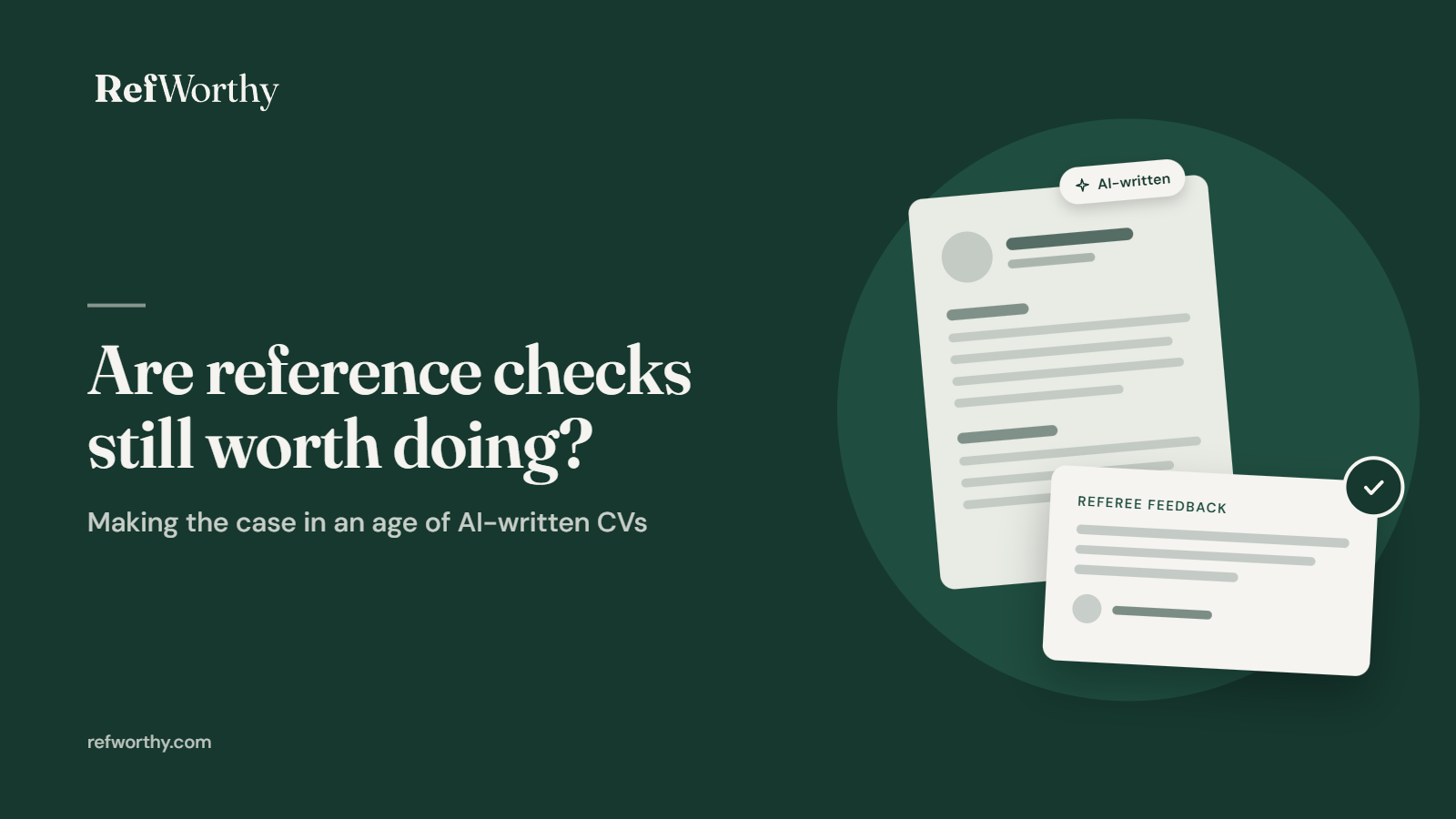
Ask any recruiter what has changed due to AI in the past two years and you'll probably hear a common answer: the CVs got better.
Spelling mistakes have vanished. Every bullet point opens with a strong verb, every achievement comes with a percentage, and every cover letter echoes the job ad almost word for word. Somewhere along the way, the average application started to read as if the same very capable ghostwriter had written it. In a sense, one had.
On the surface, that looks like progress. But it creates a real headache for anyone whose job is to tell candidates apart. When every application reads well, reading well stops telling you anything.
That raises a question for the industry. If AI can polish a CV, rehearse interview answers and, in some cases, sit in on the interview itself, is the humble reference check just another box that technology has quietly made obsolete?
We'd argue the opposite. The more of the hiring process AI can shape, the more valuable the parts it can't shape become. And a reference from someone who actually worked with the candidate is one of the few things left that a chatbot can't write for them.
What AI has done to the CV
AI hasn't made candidates dishonest. It has made every application look equally polished, and that makes the dishonest ones harder to spot.
The numbers have moved fast. In a Morgan McKinley survey of more than 2,100 people across seven markets in 2026, 63% of candidates said they use AI to write or refine their CVs and cover letters. Almost half use it to prepare for interviews.
Most of this is harmless. A candidate who uses AI to fix their grammar or tighten a bullet point isn't cheating. But it does mean the CV has quietly stopped doing one of its old jobs: showing you how someone communicates, how carefully they work and how well they understand their own experience.
The South African picture
Here, the polish problem sits on top of a fraud problem that was already serious. MIE's 2024 Background Screening Index found that 7.82% of matric certificates and 8.28% of short-course qualifications it checked were misrepresented, and 11% of international qualifications failed verification. Recruitment platform Job Crystal puts the share of education checks showing discrepancies or fraud even higher, at around 18%, according to IOL.
Platforms have also warned that AI tools can now produce a convincing fake certificate in seconds. Put that together with high unemployment and intense competition for every role, and the pressure to embellish is obvious. So is the cost of missing it.
What a reference tells you that a CV can't
A reference is evidence from someone other than the candidate. That has always been its value, and AI makes that value bigger, not smaller.
Think about where each piece of hiring information comes from. The CV is written by the candidate (and now, often, their AI tool). The cover letter, the same. The interview is the candidate performing, sometimes after hours of AI-assisted practice. Assessments help, but they test a moment, not a track record.
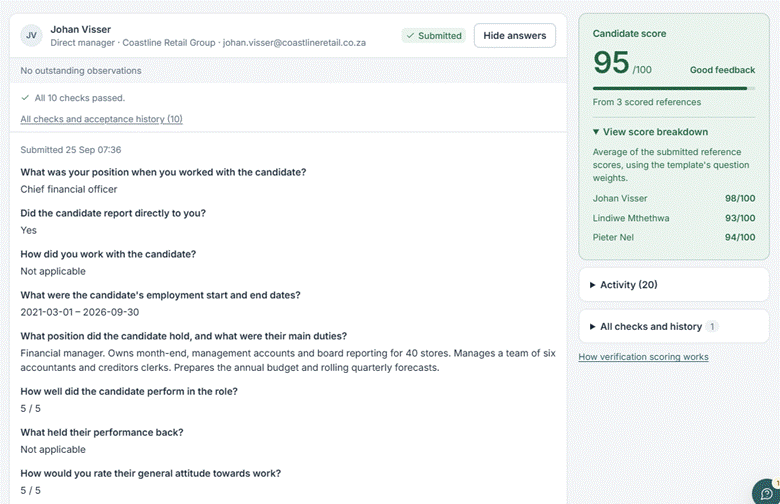
RefWorthy collects references automatically, saving recruiters time.
The reference is the one place where someone who actually worked with the candidate gets a say. Done properly, it gives you four things nothing else in the process can:
A check on the facts. Job title, dates, scope of the role and reason for leaving. These are the details a polished CV is most likely to stretch, and the easiest for a former manager to confirm or correct.
Behaviour over time, not on the day. An interview shows you 45 minutes of someone at their best. A former manager has seen them on deadline, under pressure and on a bad Monday.
How they work with people. Whether they take feedback well, how they handle conflict and whether colleagues wanted them on their team. Candidates can describe this. Only others can vouch for it.
Context for the claims. "Grew sales by 40%" reads well. A referee can tell you whether that was the candidate's doing, a team effort or a good market.
The more convincing the paperwork gets, the more that independent view is worth.
References can be faked too
The honest counter-argument is that if AI can fake a CV, it can fake a referee. It can, and that's exactly why a casual reference check is no longer enough.
The old version of reference fraud was simple: a friend answers the phone and plays the part of a former manager. The new version comes with supporting evidence, such as a matching email address, a LinkedIn profile or a company website that looks real. Gartner found that 6% of the 3,000 candidates it surveyed in 2025 admitted to interview fraud, either posing as someone else or having someone stand in for them. It predicts that by 2028, one in four candidate profiles worldwide will be fake.
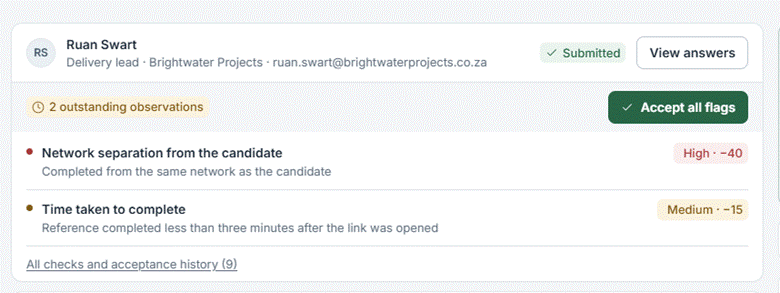
References conducted through RefWorthy go through a number of fraud detection checks and suspicious activity flags.
That doesn't make references pointless. It means the check has to test the referee as well as the candidate. A few warning signs worth watching for:
The referee can't be traced back to the company. Find the employer's details yourself, through CIPC or the company's main switchboard, rather than using the number the candidate gave you.
The referee's details came from the same place as the candidate's. The same device, the same location or an email address that closely mirrors the candidate's own.
The roles or dates don't overlap. A genuine manager should have worked with the candidate during the period being described.
A personal email address with no other confirmation. It isn't proof of fraud, since plenty of former managers have moved on, but it's a reason to verify further.
Praise with no examples. Real referees remember specific projects, problems and moments. Fake ones tend to stick to adjectives.
Several references that sound the same. Similar phrasing across referees can mean one person wrote them all, or one AI tool did.
This is where a structured process earns its keep. Tools like RefWorthy flag some of these signals automatically, so recruiters can spend their time on the references that need a closer look.
How to make reference checks worth the effort
A reference check is only as useful as the process behind it. A rushed phone call squeezed in between meetings won't catch much. A structured one will.
Get consent first, and be clear about it. POPIA doesn't stop you from checking references, but candidates should know what you'll check, why, and who you'll contact. Never contact a current employer without the candidate's say-so.
Verify the referee before you trust the reference. Confirm the company, the referee's role and the working relationship through a channel the candidate didn't give you.
Ask about what they saw, not what they think. "Tell me about a difficult situation they handled" gets you more than "Was she reliable?" Ask for examples, and ask whether they would hire the candidate again.
Ask every candidate's referees the same questions. Consistency makes the answers comparable and keeps the process fair, which matters for Employment Equity as much as for good hiring.
Collect answers in writing. Written responses give referees time to think, and give you a record you can compare across referees and share with your client.
Compare, don't just collect. Set the reference against the CV and the interview. A mismatch isn't always dishonesty, but it's always worth a conversation with the candidate.
Keep it moving. Slow references cost placements. The longer a candidate waits on a check, the more likely a faster competitor makes them an offer first.
"Most agencies know what a good reference check looks like. The problem is time. When a consultant is spending their afternoon chasing referees who haven't replied, the questions get shorter and the checks get lighter. Take the chasing out and the quality goes up on its own." — Justin Channel, Founder, RefWorthy
The verdict: more worth doing than ever
Reference checks aren't a leftover from a slower era of hiring. As AI writes more of the application, they are becoming one of the most important parts of it.
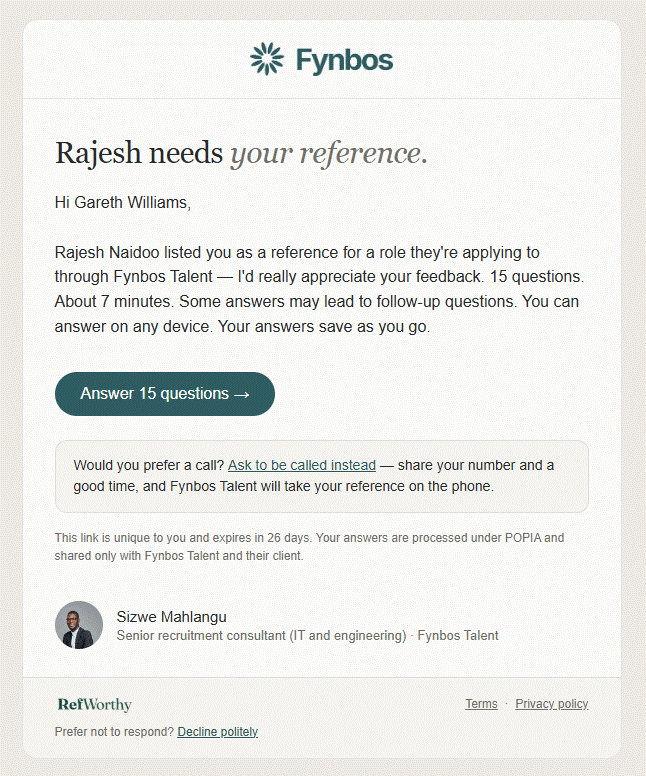
RefWorthy provides an easy solution for reference collection.
The CV tells you what a candidate wants you to know. The interview tells you how well they can present it. The reference is where someone else gets to confirm it, add to it or quietly raise a flag. In a process where the paperwork is increasingly written by machines, that human check is the part you can least afford to skip.
The agencies that do well over the next few years won't be the ones that stop checking references. They'll be the ones that do them properly, quickly and consistently, and that can show their clients the evidence.
RefWorthy helps recruitment agencies collect structured references, spot verification red flags and deliver branded reports to clients, without the chasing. Try it free with your first three candidates.