Phone or written reference checks: which gets you more honest answers?
Phone or written references? We compare both on honesty, speed and reliability, and explain why combining them gets recruiters and HR teams the best answers.

Ask ten recruiters how they prefer to check references and you'll get two camps. One swears by the phone: you hear the hesitation, you can push for detail, and nothing beats a real conversation. The other has moved to written references: they're faster, more consistent and leave a proper record.
Both camps are partly right. The real question isn't which method is better in general, but which one gets you the most honest picture of a candidate, and how to cover the weaknesses of each. Here's how phone and written reference checks compare.
The case for phone references
A phone call has one big advantage: it's a conversation. When an answer is vague, you can ask for an example. When a referee pauses before saying "she was fine", you notice. Tone, hesitation and what a referee chooses not to say can all be revealing, and a skilled interviewer can follow a thread wherever it leads.
Some referees also prefer talking. Senior people may be happier to give a few minutes on the phone than fill in a form, and some will share things verbally that they'd never put in writing.
But phone references come with real drawbacks. They take time to arrange, and trying to catch referees at the right time can drag on for days. Calls are often squeezed between meetings, so answers are rushed and off the top of the referee's head. A recruiter might ask slightly different questions, which makes candidates hard to compare fairly. Notes are also only as good as the person taking them. And on the phone, you have very little way of knowing whether you're actually speaking to the person you think you are.
That last point matters more than it used to. A friend posing as a former manager can be convincing for ten minutes on the phone, and there's nothing in a call that tells you where it's coming from.
The case for written references
Written references, especially structured online questionnaires, solve most of the problems phone calls create. Referees can respond when it suits them, often in the evening or on their phone, so there's no phone tag. They have time to think about their answers and recall real examples, rather than answering on the spot. And every referee answers the same questions, which makes candidates far easier to compare fairly.
Written references also leave a clear record of exactly what was said, rather than a recruiter's summary of it. That matters for fairness and for compliance. A written reference evidences what was actually said, which protects both the referee and the employer if there's a dispute later.
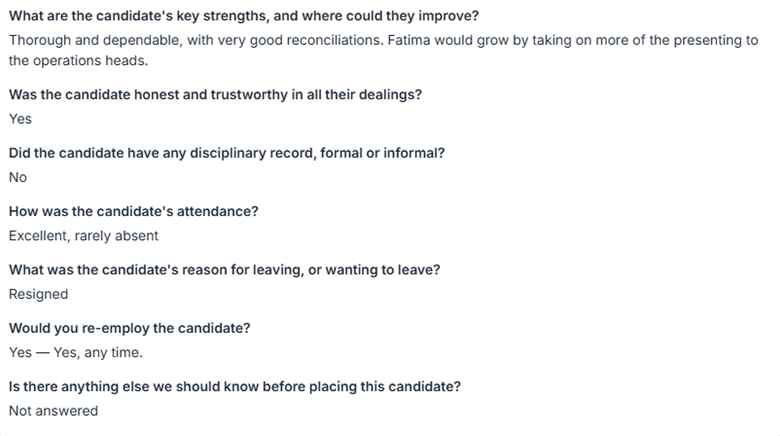
RefWorthy's template builder allows you to customise questions and give answers a weighted score.
Online references also open up verification that a phone call can't. A digital form can show where and how a reference was submitted, so it's much easier to spot one completed from the same device or network as the candidate.
The weakness of written references is that you can't follow up in the moment. A referee who gives a short, careful answer may be hinting at something they don't want to spell out. Some referees are also wary of putting criticism in writing, so they stick to safe, positive generalities.
So which gets more honest answers?
Honesty in a reference doesn't come from the channel as much as from three things: the questions you ask, how much time the referee has to answer properly, and whether you can be confident the referee is who they say they are.
On the first two, written references usually win. Structured questions that ask for specific examples ("Tell us about a time they handled a difficult client") make it much harder to hide behind vague praise than a casual "So, what was she like?" over the phone. Giving referees time to reflect tends to produce more considered, balanced answers, including on development areas. On the third, verified online references are far harder to fake than a phone call.
Where phone calls still shine is in reading between the lines. A good recruiter can hear when an answer is too careful and gently probe until the real story comes out.
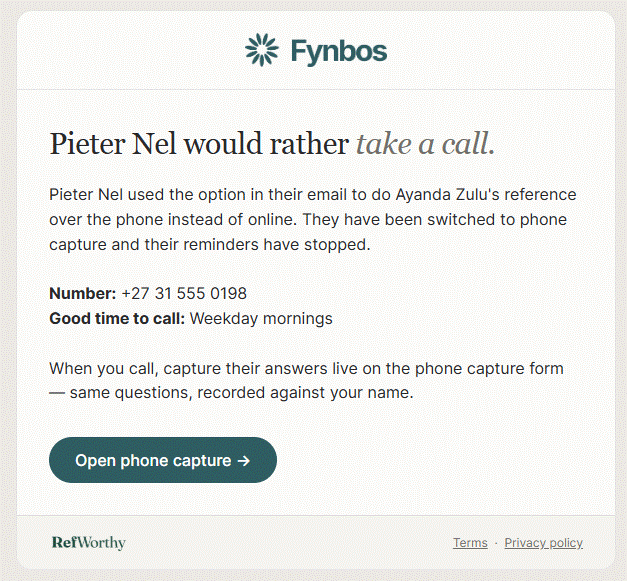
RefWorthy provides a simple solution for referees who would prefer to talk over the phone.
The best approach: written first, then a call where it counts
For most hires, the strongest process combines both:
Start with a structured written reference. Every referee answers the same, role-relevant questions through a secure online form, and you get a consistent, verifiable record.
Review the answers for gaps and signals. Look for vague responses, low ratings on key questions, contradictions with the CV, or any suspicious-activity flags.
Follow up by phone where it adds value. Use a call to gather references from referees who prefer a phone call, using the same set of questions as the online form.
Record the call properly. Add notes from the conversation to the written reference, so the full picture sits in one place.
"We built RefWorthy to support both reference types, because neither one is enough on its own. The online form gives you consistency, a proper record and fraud checks you'd never get on a call. The option to request a phone call is there for the moments when you need to hear the story behind an answer." — Madison Moulton, Product Manager, RefWorthy
Making phone references better
If you do rely on calls, a few habits make a big difference. Use the same set of core questions for every referee for the role. Confirm the referee's identity by calling through the company's main switchboard rather than a mobile number the candidate gave you. Book a time, rather than calling cold, so the referee isn't rushed. And write up your notes straight after the call, quoting the referee's own words where you can.
RefWorthy gives referees a secure online form with weighted questions and built-in fraud checks, and lets you request a phone call whenever you need to. Start free with your first three candidates.