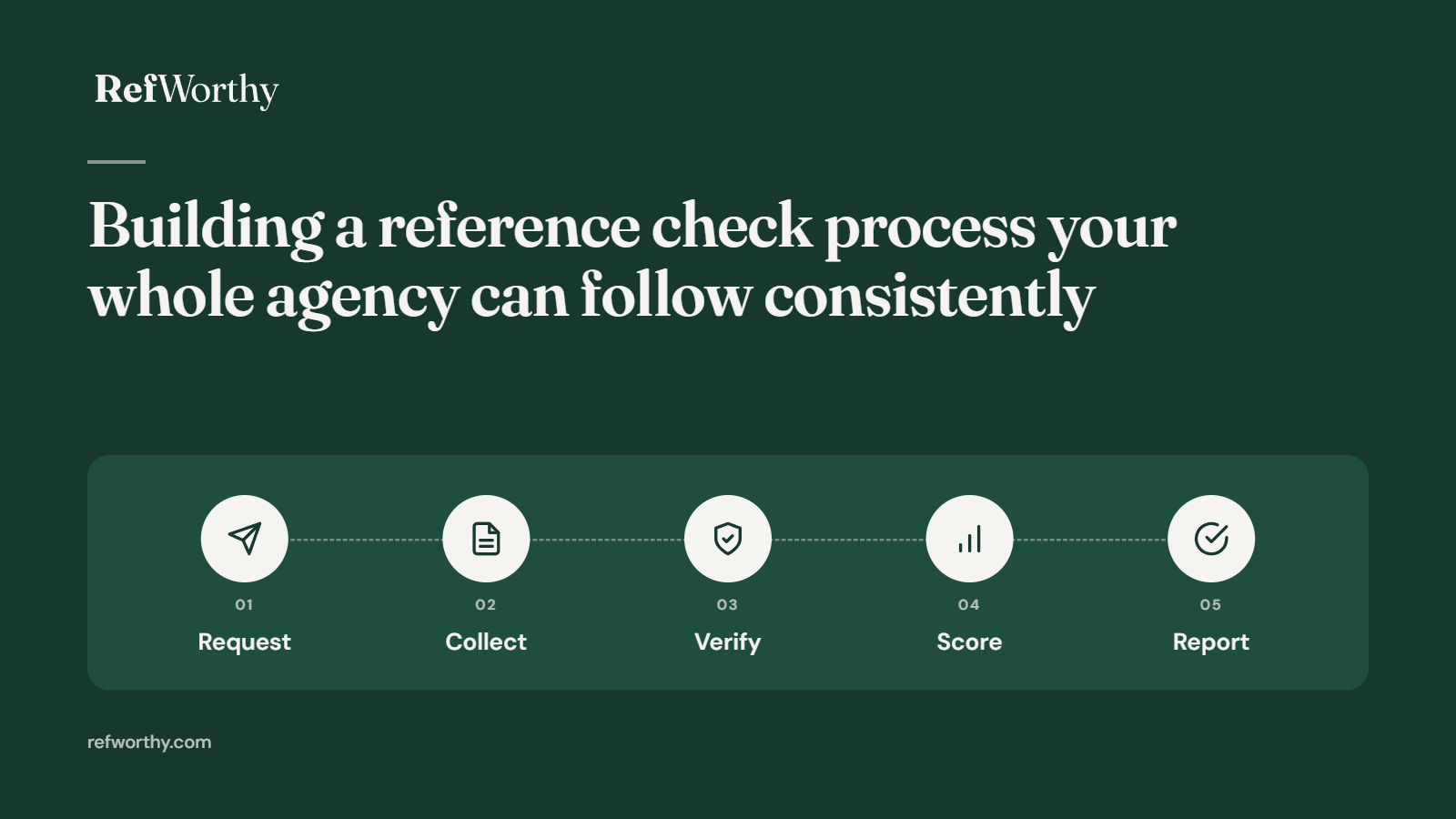
The real cost of chasing referees: how many hours does your agency lose?
Manual reference checks quietly eat consultant hours. Work out how much time and money your recruitment agency loses chasing referees, and how to win it back.
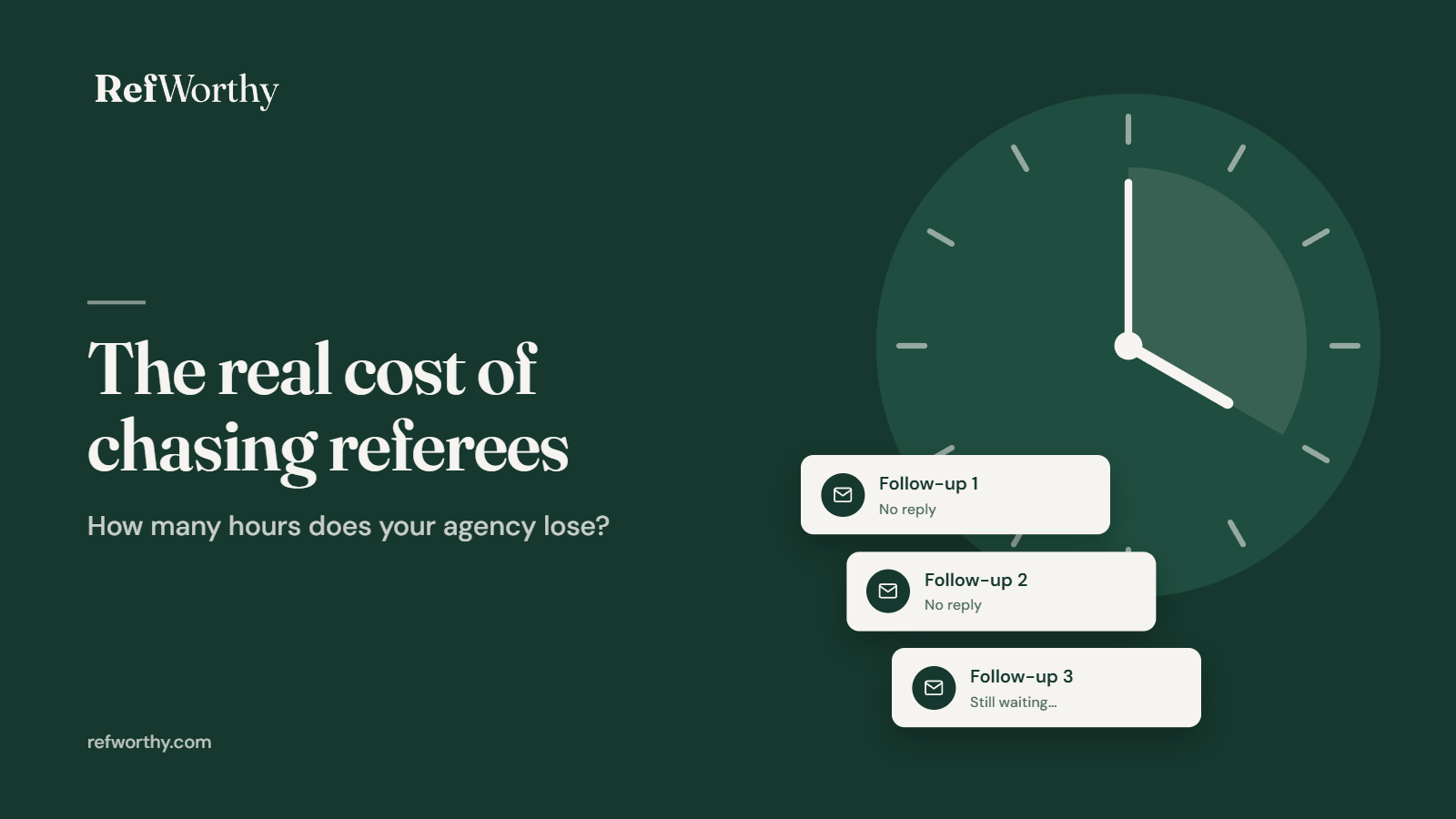
Ask a recruitment consultant how long a reference check takes and they'll probably say "about 20 minutes". That's how long the actual conversation lasts. It doesn't include finding the right number, leaving voicemails, sending follow-up emails, rescheduling a missed call, writing up notes and sending the report to the client.
Chasing referees is the kind of work that never shows up on a timesheet. It happens in five-minute gaps between other tasks, which is exactly why most agencies underestimate how much of it there is. Add it up across a month, though, and it's often the equivalent of days of consultant time.
Here's where that time goes, what it really costs your agency, and how to work out your own number.
Where the time actually goes
A manual reference check isn't one task. It's a string of small ones, often spread across several days. Here's a realistic breakdown for one referee, done by phone and email. Every agency is different, so treat these as illustrative figures and swap in your own.
Task | Typical time |
|---|---|
Getting referee details from the candidate and checking the contact information | 5 minutes |
First call attempt, voicemail and introductory email | 10 minutes |
Follow-up calls and emails when the referee doesn't respond | 15 minutes |
Rescheduling a missed or interrupted call | 5 minutes |
The reference conversation itself | 20 minutes |
Writing up notes and formatting the report | 15 minutes |
Total per referee | 70 minutes |
That's well over an hour for a single reference, and most candidates need at least two. So a single candidate can easily take two to three hours of consultant time.
A worked example
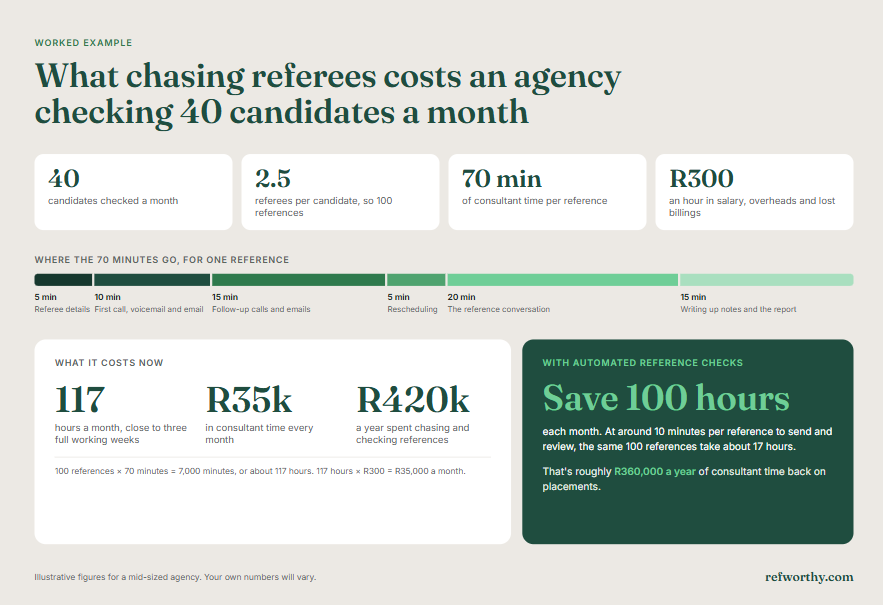
Take a mid-sized agency that reference-checks 40 candidates a month, with two to three referees each, or about 100 references in total.
At 70 minutes per reference, that's around 117 hours a month spent on reference checks. That's roughly three full working weeks, every month, mostly spent on admin rather than conversations.
Put a cost on it and the number gets harder to ignore. If you value consultant time at R300 an hour, including salary, overheads and the commission they're not earning while they chase, that's about R35,000 a month, or around R420,000 a year. And that's before you count the costs that don't fit neatly into a spreadsheet.
The costs that don't show up on a timesheet
Hours are only part of the story. Slow, manual reference checks cost agencies in ways that are harder to measure but often more expensive.
Placements that slip away. Reference checks usually happen at the very end of the process, when a candidate is ready to accept. Every day spent chasing a referee is a day the candidate might accept another offer.
Frustrated clients. Hiring managers notice when references drag on. A client waiting days for a reference report starts to wonder what else is slow, and whether the next agency would be quicker.
Rushed, inconsistent references. When chasing eats up a consultant's day, the actual conversation is the part that gets squeezed. Questions get shortened, notes get thinner and different consultants ask different things, which makes references less useful and harder to compare.
Consultants doing the wrong work. Your best consultants are good at building relationships with candidates and clients. Every hour they spend leaving voicemails is an hour not spent on the work that actually brings in revenue, and few people join recruitment because they love admin.
Work out your own number
You don't need a time-tracking project to get a useful estimate. Ask two or three consultants to note how long they spend on each step of their next few reference checks, from first contact to sending the report. Then plug the averages into this simple calculation:
References checked per month × minutes per reference ÷ 60 = hours per month
Hours per month × hourly cost of a consultant = monthly cost
For the hourly cost, include salary, benefits and overheads, and consider adding a figure for the billable work consultants could be doing instead. Don't be surprised if the result is higher than you expected, mostly because the follow-up and admin time is so easy to overlook.
It's also worth tracking how long reference checks take in calendar days, not just hours. A process that takes two hours of effort but four days to complete is costing you in candidate experience and placement risk, even if the hours look manageable.
How to win the time back
Most of the time lost to reference checks isn't spent on the useful part, the referee's actual feedback. It's spent getting to that point. That's the part to cut.
Get the right details up front. Ask candidates for referees' full names, current job titles, work email addresses and how they worked together, all at the start. Ask them to let their referees know a request is coming. A referee who's expecting you tends to reply much faster than one who isn't.
Move to writing. A short online questionnaire that referees can complete on their phone, whenever it suits them, removes phone tag almost entirely. It also gives you consistent answers and a written record, rather than notes typed up from memory.
Automate the follow-ups. Reminders shouldn't depend on a consultant remembering to send them. Set them to go out automatically after a set number of days, so references keep moving even when your team is busy.
Make requests look genuine. Referees are rightly wary of unexpected emails. Requests sent from your agency's own email domain, with a clear explanation of who's asking and why, are much more likely to be opened and answered than ones from an unfamiliar address.
Save calls for where they add value. Once written responses are in, use phone calls to follow up on specific answers, not to start from scratch. A focused ten-minute call is far more useful than a general 20-minute chat.
This is the approach RefWorthy is built on. Referees receive an email from your own domain with a link to a structured online form, and RefWorthy sends automated reminders until they respond. You can request a phone call whenever you need one. Your consultants' time goes into reviewing references, not chasing them.
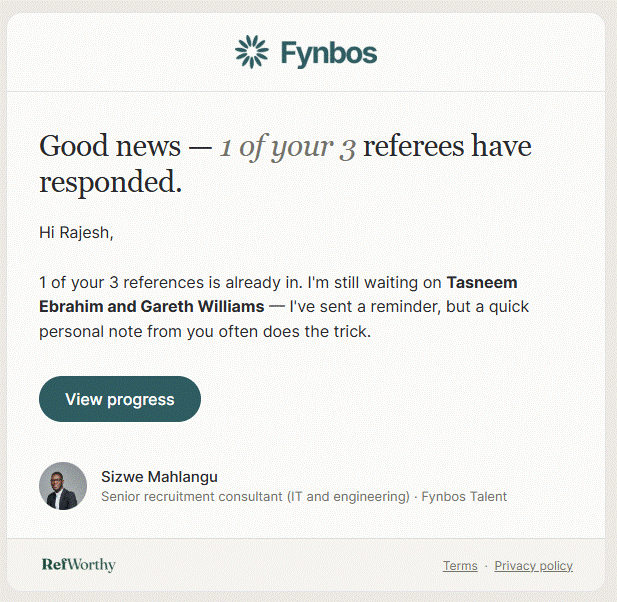
RefWorthy sends automated reminders on your schedule.
To see how much difference that makes, go back to the worked example. If a consultant's part drops to around ten minutes of setup and review per reference, the same 100 references a month take about 17 hours instead of 117. That's 100 hours a month back for the work that actually wins placements. These are illustrative figures, so run the numbers with your own data.
Stop paying for the chase
Reference checks matter. Chasing referees doesn't. Most agencies lose far more time to the admin around a reference than to the reference itself, and that time comes straight out of placements, client relationships and consultant energy. Work out your own number, then cut the chasing out of the process.
RefWorthy sends reference requests from your own domain, follows up automatically and gives referees a simple online form to complete, so your consultants can focus on placing candidates. Start free with your first three candidates.